Here Is Your King

Bob Turner
April 3, 2026
Read John 19:1–16
Last weekend millions of people across the country, and even in some European cities, gathered in the streets for the latest of what have become known as “No Kings” rallies. It was a form of protest against what many people consider to be the president’s executive overreach that, they say, resembles the actions of a monarch or dictator more than a democratically elected president. In keeping with the insistence of the framers of the Declaration of Independence and the Constitution, the protesters proclaimed that in the United States we have, and we are meant to have, no kings.
I would modify that statement, however, in light of the events of the first Good Friday, which we commemorate tonight. We who are followers of Jesus have no kings…but one. Let us look to where Pilate is pointing and bow down in worship when he says, “Here is your king!”
As I have noted before, Jesus is a curious kind of king. Like so much else in his life and ministry, his identity as a king is surprising and counterintuitive. In his declaration that the last will be first and the first last, in his demand that those who wish to be great must become servants, and in his willingness to take on the role of a slave in washing his disciples’ feet, Jesus signals an upside-down kind of kingdom. He does not live in a palace; instead, he has no place to lay his head. He rules not with scepter and orb; instead, he serves with basin and towel. He does not command a vast army and navy; instead, his followers are a handful of peasants and fisherfolk. He has no security detail, nor does he ride in an armored car with bulletproof windows; instead, he tells Peter, when that disciple tries to defend him violently, to put away his sword, and he himself goes unarmed and physically vulnerable into the jaws of the beast of empire.
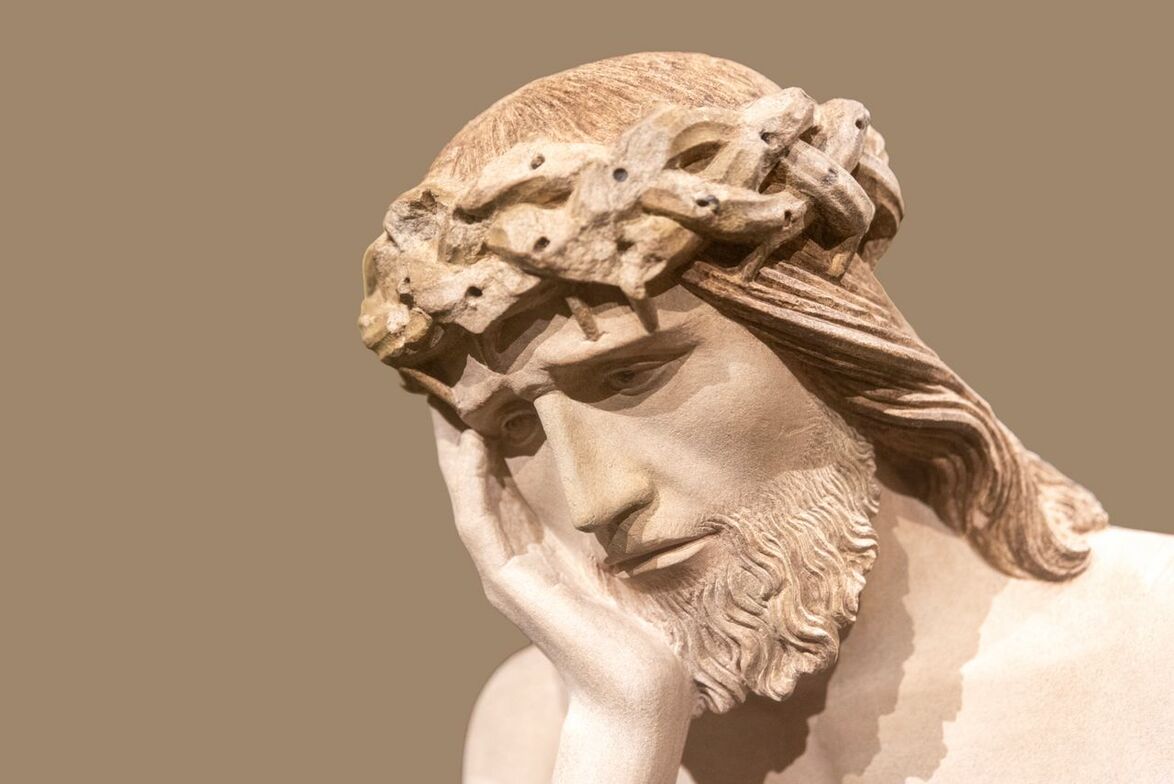
And yet he is the king. John depicts Jesus as simultaneously ragged and regal. When Pilate says to the Jewish leaders, “Behold the man!” and later, “Here is your king!” he is clearly speaking ironically. Jesus, after all, has just been whipped with a Roman flail, his flesh torn by leather thongs tipped with bits of iron and bone, and crowned with a ringlet of thorns. Staggering in pain and exhaustion, blood pouring down his forehead and face, he must make a pathetic sight, even dressed in the purple robe the soldiers have mockingly thrown over his shoulders. Pilate wants Jesus’s accusers to see how ridiculous are their claims that Jesus represents any kind of threat.
But John is better at irony than Pilate is. He knows the counterintuitive truth that this seemingly helpless victim of imperial violence and priestly intrigue is really the king not only of “the Jews,” as Pilate calls him, but of the cosmos. It is at the name of this pitiful figure that Paul says “every knee should bend, in heaven and on earth and under the earth, and every tongue should confess that [he] is Lord, to the glory of God” (Phil 2:10–11). John knows that the crown and robe, meant as mockery by Jesus’s persecutors, are really regal symbols, just as he knows that the cross that awaits, “the emblem of suffering and shame,” as the old hymn puts it, is really a throne.
“Here is your king!” Pilate tells the priests and scribes, and they respond with bloodthirsty malice, “Away with him! Away with him! Crucify him!” (v. 15). They have already issued a thinly veiled threat to Pilate when they perceived he was angling to release Jesus: “If you release this man,” they warn, “you are no friend of Caesar. Everyone who claims to be a king sets himself against Caesar” (v. 12).
This is a message we should remember. It recalls something Jesus said back in the sermon on the mount: “No one can serve two masters, for a slave will either hate the one and love the other or be devoted to the one and despise the other” (Matt 6:24). In the context of the sermon, Jesus is talking about the impossibility of serving God and wealth simultaneously, but in a broader context he is talking about our most essential allegiances. In the Lord’s Prayer we declare, “Thine is the kingdom and the power and the glory forever,” and when we assign these things to God we by necessity withdraw them from any other claimant. It’s just like the essential Christian confession, “Jesus is Lord”—it is a pledge of our allegiance to one and only one king. No other power on earth, whether political party, ideology, corporation, church, employer, charismatic leader, or any other power, can share our pledge of loyalty. Any commitment we make to one of these lesser gods must kneel in subservience in the face of the lordship of God in Christ. God’s is the kingdom and the power and the glory. Jesus alone is Lord. Truly, one who makes these declarations is no friend of Caesar.
The priests and scribes make their choice, and it is a fateful one. When they demand Jesus’s death, Pilate asks, “Shall I crucify your King?” (v. 15). He is still provoking them, knowing that to refer to Jesus in his ironic way as their king will set them off, and he is right. The chief priests say the quiet part out loud. They are supposed to be the leaders of the people, agents and mediators of God, those who are most committed to the covenant, but they chuck it all for a dose of temporal power. “We have no king but Caesar,” they say, in words that echo down the centuries in ominous tones fit for a Robert Johnson blues. They have stood at the crossroads. They have sold their souls.
Pilate says to us, “Here is your king!” and tosses the ball in our court. Will we acknowledge the kingship of Jesus, laying aside every other allegiance, or will we too sell our souls, saying, “We have no king but Caesar”? When agents of the government pray “in Jesus’s name” for the violent destruction of our enemies, will we bow our heads and pray along? When religious and political leaders tell us it is okay for us to despise and treat with contempt people who look different or love differently or speak with a different accent because we are the chosen ones and God favors us above all others, will we accept this as gospel? When these leaders tell us that God endorses our violence and when they depict Jesus as a figure more closely resembling Rambo than the Man of Sorrows, will we say, “By jingo, you’re right!” and goose-step off to war? Or will we stand up against these lies and choose instead the man with the broken jaw and the cauliflower ears, the one with the blood and spittle running into his beard, the one with bloody stripes criss-crossing his back and a thorny crown encircling his brow? And when he takes up his cross and stumbles his way to Golgotha, will we take up our own and follow him, saying with our dying breath, “Here is our king”?

-
Community UCC
-
Schwarzwald UCC
-
Trinity UCC
Office Hours
Contact
© 2026 Community UCC. All Rights Reserved.
|
Login
powered by
Website Developed by Tithely